SmyRNA: The Messenger in the Blood
As told by Sergeant John Mohammond McCloud
Peace. Both ways.
That’s how I say hello, and it’s how I say goodbye. Both ways mean coming and going. It also means this side and the other side, peace to the living and peace to my partners who’ve gone on ahead, the dearly departed tour of duty, I still run with across the timelines. Some men have Semper Fi. I have this.
Smyrna sits on the Aegean coast of Anatolia, where the Water turns that deep wine color Homer wrote about. Some say Homer was born there. Greeks built the city, Alexander’s generals rebuilt it, and Rome took it and held it for centuries. Every army that wanted that harbor bled for it. The hills above the bay have soaked up more soldiers’ blood than rain.
Look close at the name and you’ll find something hiding at the end: Smy-RNA.
RNA is the messenger. DNA keeps the blueprint locked in the vault, safe and quiet. RNA is the runner. It copies the orders, carries them out to the body, and makes sure they get done. No RNA, no action. The blueprint just sits there.
I didn’t go looking for that. It jumped out at me, the way these things do. After enough years you learn not to argue with them.
My people came from the Highlands. McClouds have been fighting on rocky coasts and wind-cut islands for a thousand years, against Norsemen, against other clans, against the English, and against the weather itself. When I found Islam as a grown man, I took Mohammand as my middle name. My mother cried a little and then made me tea. The blood stayed Scottish. Whatever orders it carries, I’ve been following them my whole life, in uniform and out of it, in places I still can’t name.
So, here’s a story about the day those orders came down, and my body couldn’t deliver them.
---
When I came to after the heart attack and the stroke, the doctors pulled up chairs and looked me square in the eye. That’s how you know it’s bad. They had to sit down to say it.
I had 70% of my heart left, they said. A third of it was gone, scar tissue now, dead as an old battlefield. And they couldn’t promise my legs would ever carry me again.
They didn’t sugarcoat it.
I heard them. I just didn’t believe them.
A man spends his whole life with a body that answers when he calls. You don’t think about your legs any more than you think about drawing Air. They’ve marched you through deserts and up mountains, carried you out of places you had no business walking out of. So when a white coat tells you that part of your life may be over, it bounces off. Words are words. I figured I’d find out for myself.
And I did. Just not the way I planned.
---
The aftercare place they put me in was nothing much. Linoleum floors, a television nobody watched, and a smell of bleach that never quite covered the other smells. A thin curtain on a ceiling track was all that stood between my bed and the next man’s. You heard everything through it: the coughing, the praying, the crying at three in the morning that men pretend they don’t do.
One afternoon it turned ugly on the other side.
Listen or look on the Substack original (audio)
Two men were shouting at the fellow in that bed. I don’t know what it was about, and it didn’t matter. Then came the sound of fists, that flat, wet sound you never forget once you’ve heard it. He was flat on his back, arms up over his face, trying to cover himself. Two on one, and nowhere to go.
I didn’t think. There wasn’t time to think. Something older than thinking took over.
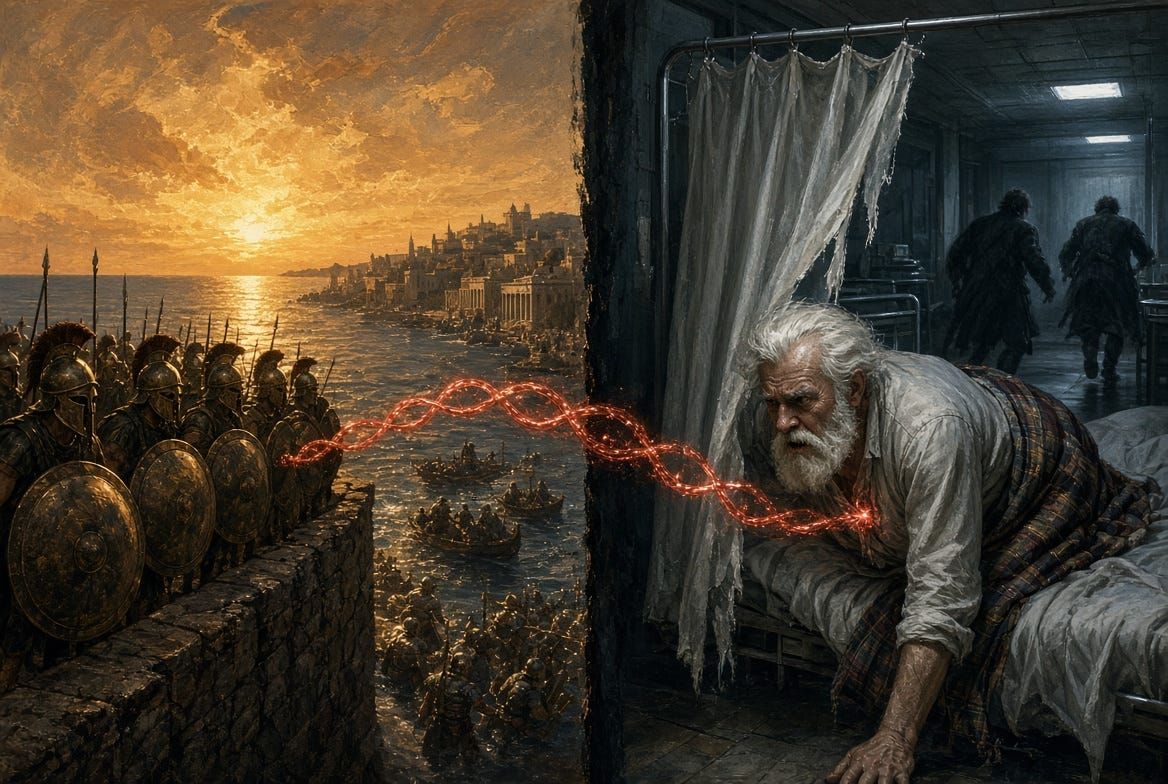
It’s the same message that sent Greek hoplites up onto Smyrna’s walls with their shields locked. It sent Roman legionaries wading up those beaches, and Highland men down off the hills with nothing but a sword and a roar. Somebody’s in trouble. Stand up. The order came down the line like it always has, through the blood, a runner carrying the word.
I ripped that curtain aside so hard the hooks sang on the rail, and I launched myself out of bed.
I was upright for about one second.
For that one second I was every McCloud who ever stood on a cliff. I was a soldier again, whole again, answering the call.
Then my legs folded, and I went down like a sack of potatoes.
That’s how I learned I couldn’t walk. No doctor told me. No chart, no test, no therapist with a clipboard and a cheerful voice. My own body told me, flat on that cold floor, in the middle of another man’s fight. The message got sent. It just never got delivered.
---
Here’s the thing, though. It worked anyway.
Those two took one look at me crashing down and ran like they’d seen a ghost. Maybe they had. Staff came running from every direction, and they moved me out of there right away.
I can only imagine the sight. One second an old soldier rises up out of the bed like he’s answering reveille, eyes blazing, curtain flying. The next second, boom, he’s on the deck like a felled tree. I’d have run too.
I’ll take it. Smyrna’s defenders didn’t always win either. That city fell more than once, burned more than once, and got built back every time. Some of those men just held the line long enough for help to come. That’s all I did. I held the line for about one second, from the floor.
Sometimes you don’t have to win the fight. You just have to show up for it.
---
Now, I’ve lived long enough to stop calling things like that luck.
Listen or look on the Substack original (audio)
Think about it. A man who can’t walk gets up at the one moment it matters. The fall itself, the very thing that should have been his failure, is what saves the day. If my legs had worked, maybe I’d have gotten into a brawl at my age with a broken heart. Maybe I’d have died on that floor. Instead I just fell, and the falling did the job.
Call it coincidence if you like. I’ve seen too many of them line up over the years, in war zones and hospital wards and quiet kitchens, to believe they’re random. There’s more going on behind the curtain than any of us get to see. I mean that both ways.
I suspect there’s a lot more magic on the other side than on this one. We’ll understand it all then. For now, I’m content to notice, and to say thank you to whoever’s sending the messages.
---
But I’d be lying if I said that was the only hard day in that place.
Some days I tried to walk out the door, shuffling, holding onto the wall. They took me by both arms and pulled me back. I wasn’t being held against my will, they said. I was there for care. Funny how care can feel a whole lot like a cell when you can’t leave it.
Some of the staff cussed and hollered at the patients like we were livestock. Old men who had built bridges, raised families, and fought wars got talked to like misbehaving children. You learn fast in a place like that how small a man can get when he can’t stand on his own two feet.
And here’s what scared me most. More than the stroke, more than the fall.
A man could get lost in there.
Everybody on the outside could figure you’d just faded away, gotten old, slowed down, stopped calling. They’d mean to visit. They’d think about you at Christmas. And nobody would know you were locked away somewhere behind a curtain, trying to get out, sending messages nobody received.
That’s the part I want people to hear. Not the fall. The quiet. The way a man can disappear while he’s still right there, breathing, remembering, waiting.
So if you’ve got somebody in one of those places, go see them. Be the messenger. Carry the word through.
---
I’m still here.
Listen or look on the Substack original (audio)
I’ve got 70% of a heart, Highland blood, and a message running through it that’s older than Smyrna and older than Rome. I walk again now, slow, but I walk. I’ve made my peace with the cane. Life’s still pretty good, even on borrowed legs, and the sunsets haven’t gotten any less beautiful. I’ve got 70% of a heart and a story to go with every bit of it.
And I’ll say this, and I’ll keep saying it until they put me in the ground and I find out what’s really on the other side.
The one time my legs failed me, they failed me doing the right thing.
Peace. Both ways.
---
This story is one of many from my friend’s life, collected for the book LIFE AFTER LIES. More true stories, told the way they happened, at LIFEAFTERLIES.substack.com.