X
How the papers built a devil and rented him over half of a century. The date does not care who you are. It keeps a ledger. It files an emperor, a cook who did not look sick, a nurse who never blinked, a boss who sang from inside a killer’s car, a lyricist who named the gentle Family, a president talking to a dog, a woman who put free love on a ballot, a phantom under an opera house, two men who could actually play, and a wedding that would later baptize a farm.
Then the twentieth century slides a mugshot across the same page and asks the reader to believe the mugshot explains the whole stack. That is how a folk devil is housed. Not by physics. By filing.
Start with the part the legend keeps hoping you will skip. He was not in the house on Cielo Drive. The people who did the killing had names. The next night he was in another house and tied two people up and left the rest to the same small army. A jury later said conspiracy.
That is already enough for a life sentence and a permanent stain. It was not enough for the market. The market wanted a prophet of hell. It did not want a philosopher. It did not want an artist. It did not want ATWA. So a prosecutor gave it the first of those and buried the rest.
Race war. Beatles as scripture. A hole in the desert. A white king waiting to walk out over the ashes. It is a remarkable story. It is also, piece by piece, the story a man tells a jury when he needs one mind to hold seven deaths, and then the story a man tells a publishing house when the verdict has made him famous.
Cops who worked the edges of the case would later shrug and say the race-war talk was a camp philosophy, not a blueprint. Near the end of his life the prosecutor himself allowed that he did not think Manson believed the pit.
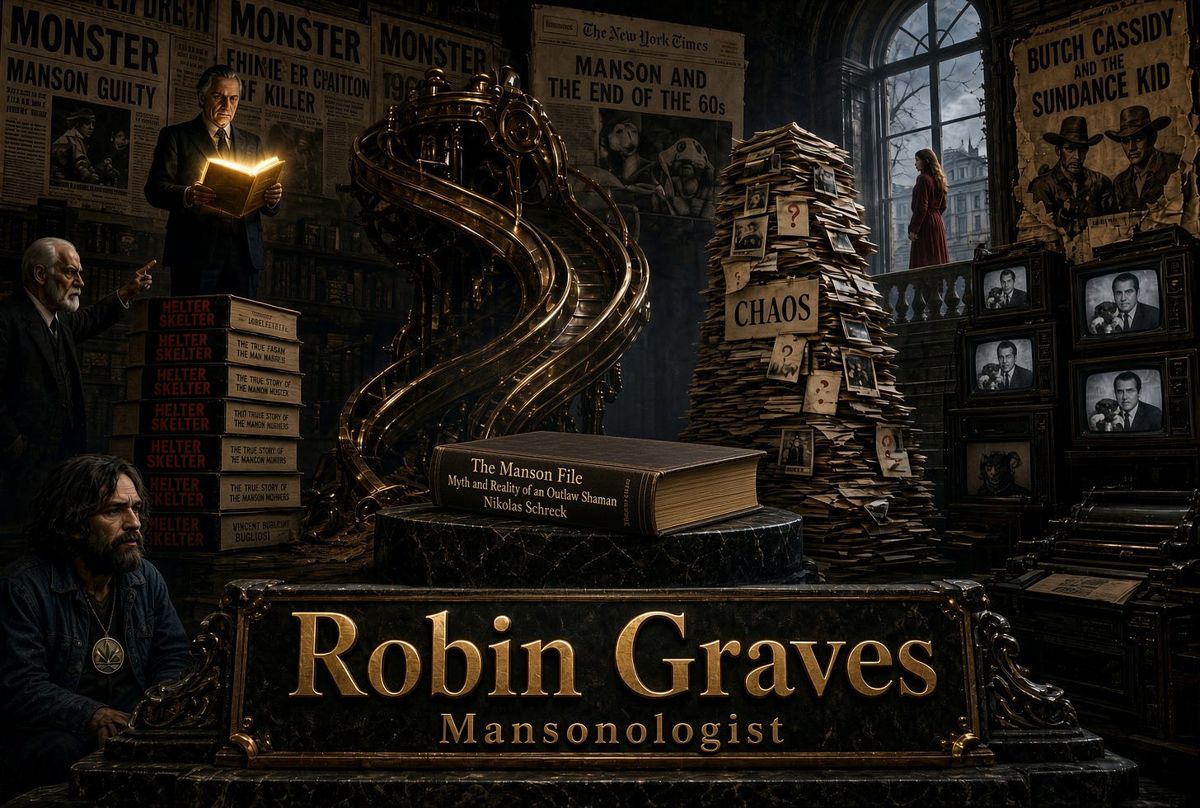
The paperback did not print that shrug on the cover. The paperback had already become the country. It has been collecting rent on that cover for more than half a century. Watch how the extras get bolted on. The papers call him a hippie because long hair photographs like a verdict against a generation. He understood costume the way a writer understands a mask.
They write him into the room on Cielo Drive because “Manson killed Sharon Tate” is a sentence that fits a headline. He was elsewhere. They empty the women of will because dolls are simpler than adults who chose a night. They add firelight and chanting that no witness is asked to swear to. They add Satan because Satan is already in the props department.
A university reading of the Times across the trial months finds the paper hanging “supernatural properties” on a defendant as if it were covering a saint in reverse. That is not a leak from the desert. That is craft. Then comes the small cruelty that keeps printing itself: the recasting of the music.
Charlie was not a man the industry could afford to remember as an artist, so the copy made him a stray who never belonged in the room. He belonged in the room. He wrote. He played. He hunted a hearing the way any serious American songwriter hunts a hearing. Neil Young did not describe a void. He described a force a little larger than the session could hold.
Later the same mind gave the force a public name that had nothing to do with a prosecutor’s slide: Air, Trees, Water, Animals. ATWA is philanthropy aimed at the living world instead of a foundation plaque. The news had no use for that sentence. A boogeyman does not get to be a conservationist. A boogeyman does not get to be a philosopher. A boogeyman has to stay hungry in the photograph. He saw the craft and fed it anyway. The stare. The carved forehead. The line about the Charlie they created being an illusion. Tricksters love a mirror.
The mistake is to take the mirror for the man and then write fifty-plus years of history from the reflection.
Now let the date talk, because the date is the only honest witness in the pile. It does not say he met these people. It says the culture already knew their jobs. Freud dies on this day in 1939 and leaves behind a map of groups that marry a father and park their hate outside the tent.
Thirty years later a clinical essay cannot discuss the public id without quoting Manson. That is not proof of destiny. It is proof that when America needed a walking id, it did not invent a category. It cast a convict who was also a writer. Tolstoy marries on this day in 1862.
A century on, a reporter cannot praise a working farm without first rinsing Manson through the sentence—“the ’60s communes that Charles Manson gave a bad name to.” Listen to the grammar. The farm is clean because a name was found to hold the dirt. Anthropology has a word for that procedure. Journalism calls it color.An emperor is born. A Beatle says his slide was Rome falling as a fairground joke.
The prosecution hears a war-drum. Between those two hearings sits the entire scam of Helter Skelter as national myth: a carnival image, seized, sworn, bound, sold. Louise Fletcher dies and takes Ratched with her. One woman in white who shrinks people for their own good; one man sold as the proof that the unlocked door was worse. The country used both rooms. It still does. The question “who is crazy” was never a medical question on that stage. It was a property dispute over the keys.
Typhoid Mary is born. She cooks. She is not the only carrier. She is the one the city can see. Nicknames are cheaper than systems. Decades later the system needs another nickname for a season that frightened it. It does not invent a new procedure. It repeats Mallon’s.
Springsteen is born and will, in time, put a listener inside Charles Starkweather’s mouth and admit a meanness that needs no White Album. The road already knew how to do this. 1969 just gave the road a theologian and then refused to admit he was also trying to write songs and save trees.
Hunter dies in San Rafael, having written the long strange trip for the Family that did not become a warrant. Two Californias tried to occupy one word. Only one of them got to keep it in the present tense.
Nixon, 1952, lifts a dog into the lens and saves a career. The intimacy machine is switched on. Twenty-three years later a woman in red from the old ranch lifts a .45 toward the man who pardoned that career. Four rounds in the magazine. Nothing in the chamber. The legend prefers the round that almost flew, because the almost-round keeps the devil current. The chamber is the tell. Folklore hates an empty chamber.
1973 takes Neill and Neruda on the same grid: the school that refused to break the child, the poet who thought history could be sung into justice. After the trial, every unlocked classroom and every revolutionary kitchen has to pass through a metal detector of one name.
That is not scholarship. That is a curse the papers maintained because curses organize fear. In New York, the same autumn as the murders, Newman and Redford bow as charming thieves. The front pages need the other pair, the ones who do not freeze-frame well.
Outlaw splits into poster and mugshot. Guess which file stays open. Woodhull says she will love whom she may and runs for president. A later household puts the same American argument in a transcript and the news acts as if the argument began in 1969. It did not. The grotesque heir is easier to hate than the woman on the ticket.1909: a masked musician takes up residence under the house of entertainment. 1930 and 1926: Ray Charles and John Coltrane arrive on the calendar like a challenge, not a rebuke.
The man who wanted their industry did not come as a beggar. He came as a song writer who believed the studio, the ranch, and later the whole biosphere were the same instrument. ATWA is what that belief looks like when it stops asking a label for permission. The papers declined the instrument. They kept the mask.
The scare, if you still want one, is not that a calendar is haunted. The scare is how little of the haunting was done by the defendant. He supplied a stare, a ranch, a catalog of songs, a household, and a late doctrine that named the air and the trees as the point. The copy desk supplied omniscience. The bestseller supplied a cosmology the author later half-disowned.
The photograph supplied a face the machine could caption as an entire generation. The anniversary machine still supplies the rest: corridors of conjecture, body counts that wander, a president’s empty chamber reloaded by memory, and the cheap lie that the music was nothing. O’Neill, who spent twenty years pulling nails out of the official story, was careful in the only sentence that matters—he set out to prove the official story was not what happened, not to replace it with a prettier innocence. Innocence is not the offering. A smaller, stranger, more complete person is.
That person does not photograph as the end of the 1960s. So the papers kept the larger doll, and they have been cashing the lease since 1969. The date will do this again tomorrow under another set of names. Fathers, farms, folk devils. The ledger does not care. It only shows you the rooms. The news decided which tenant was too useful to evict.
Manson died in a hospital bed in 2017. The creature they needed did not. It still collects.