The English word coincidence entered usage around sixteen hundred, from medieval Latin coincidere, to Fall upon together. This paper traces the word’s roots, surveys its equivalents, and examines how the religions have framed the concept, from hashgacha pratit to Jung.
Etymology:
The English noun dates to circa sixteen hundred, from French coincidence, from coincidere, to Fall upon together, from com- plus incidere, from the root kad-, to Fall. The sense of an accident appears in the sixteen eighties, possibly first in Thomas Browne. Before that it meant an exact match. Astrologers used the verb for planets falling on the same point.
Cognates:
The same root yields Latin casus, a Falling, hence chance, and English case, casual, accident, and chance, the last via Old French cadentia, the ways the dice Fall. German Zufall is the Latin for what Falls upon, said in German. Dutch toeval is the same image. Sanskrit sad- means to Fall down. Greek symptosi is together plus to Fall. A symptom is the medical cousin.
The Hebrew claim:
The line that Hebrew has no word for coincidence is a theological slogan, not a lexical fact. Biblical Hebrew has mikreh, from qarah, to encounter or Befall. The lexicons say accident, chance, fortune.
Ruth 2:3 marks her hap as chance from where she stood. First Samuel 6:9 sets chance against the hand of God.
Modern Hebrew is plain.
Bemikre means by chance.
Tseruf mikrim, a combination of occurrences, is the ordinary word.
What the teaching refuses is that the word names something truly uncaused. Jonathan Sacks noted that mikreh, chance, and mikra, a calling, are almost the same sound.
The Baal Shem Tov line, that by him there is no coincidence, is an instruction about attention, not a missing entry.
Cross-linguistic equivalents
Most terms cluster into three metaphors.
Falling together:
English.
French.
Italian.
Spanish.
Portuguese.
Greek symptosi.
Russian sovpadenie.
German Zufall.
Dutch toeval.
Happening or encounter. Hebrew mikreh. Arabic sudfa is plain chance. Ittifaq is coming into accord. Persian and Urdu follow Arabic. Turkish tesaduf is an everyday surprise. Sufi tevafuk is not a bare chance. It is a correspondence that feels appointed.
Joining or opportune fit:
Chinese qiaohé, opportune plus join.
Japanese guzen is a chance set against hitsuzen, which had to happen.
Korean is built the same way.
Hindi samyoga, and the Sanskrit under it, is a yoking.
On the street Hindi and Urdu often reach for the Arabic-Persian word for agreement.
Synchronicity itself is almost always a modern loan, not an old native word.
Religious framing:
Judaism splits providence. Klalit is the general. Pratit is the particular. Maimonides held that no event is too small. Christianity, through Augustine, says chance is a cause you cannot see.
Islam puts every event under qadar and still leaves the person responsible. Tevafuk names the felt match without dropping the decree.
Hinduism and Buddhism set the same events inside karma. Dependent arising says nothing starts alone, so a random coincidence is already the wrong cut.
The I Ching reads the hexagram as a picture of the moment, not a lottery. Jung met that book through Wilhelm, and that meeting is the seed. Yoruba Ifá reads a cast the same way, and it did not come from the I Ching.
Jung’s synchronicity:
What grew from that seed is synchronicity. In nineteen fifty-two he wrote it as a state of mind and an outside event at the same time, lined up in meaning, and in some cases with no cause between them.
He called it an acausal connecting principle. He had the word by the late nineteen twenties. He said it in public in nineteen thirty, at the memorial for Wilhelm.
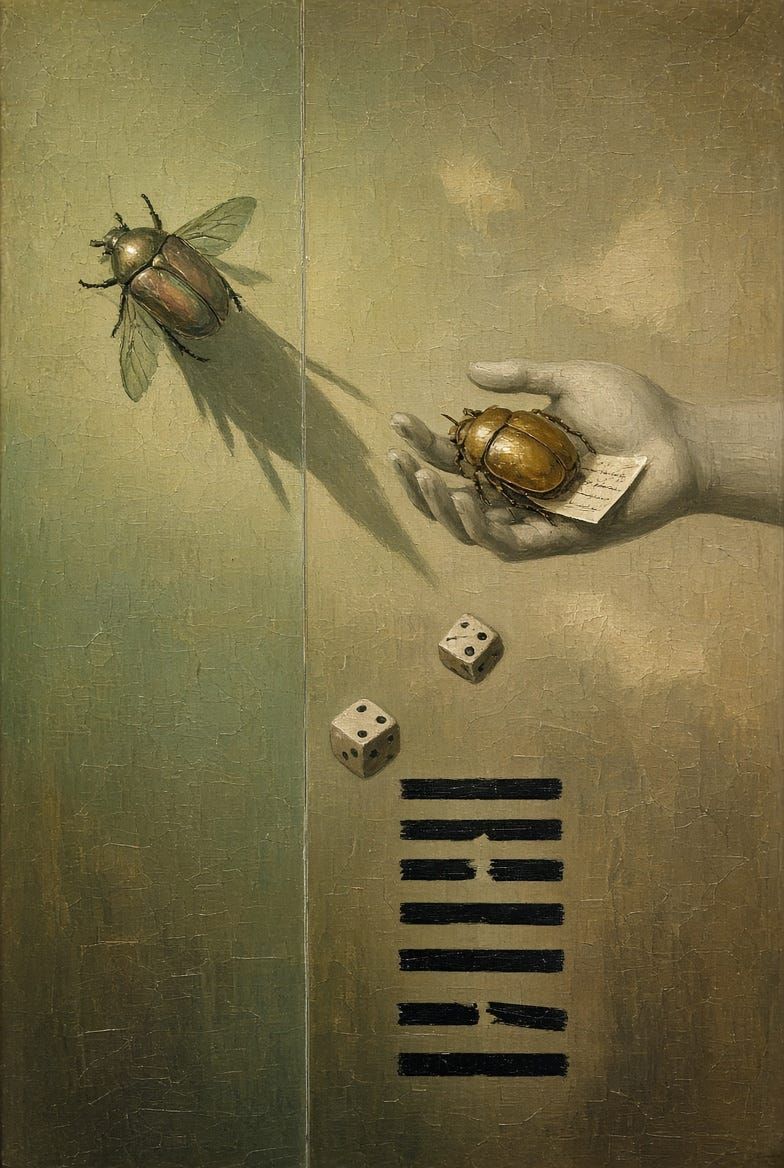
The scarab is the case people repeat. A woman told him a dream of a golden scarab. While she talked, a beetle tapped the glass.
He caught a rose-chafer, the nearest thing Switzerland has, and put it in her hand. Pauli worked on the physics side with him. The book is The Interpretation of Nature and the Psyche.
Jung said his feelings about time began at dinners with Einstein in Zurich around nineteen ten. He split it. Narrow is the meaningful coincidence. Wide is order without a cause. His connector was the Archetype. The religions say God, karma, or fate. Coincidence is the secular name for the same hole.
The critique:
Koestler hit it hardest. If you can call any pairing meaningful after you see it, you cannot test it, and the stories were never collected as a set.
The numbers answer from the other side. Diaconis said that with enough people, a one-in-a-million event is an ordinary day.
In that sentence the millionth monkey shows up, Brad Pitt in 12 Monkeys, the word said over until monkey becomes moon key, a made rule for getting to the moon. A shame the film was not 13 Monkeys. A moon year runs closer to thirteen moons, so the keys should have been thirteen, not twelve.
In a room of twenty-three people, two of them share a birthday about half the time. Defenders say the rare thing is the personal hit. Critics say that is only remembering the hits.
What is left:
The mind scientists call it pattern-seeking. The word stays, for meaning that is felt. The principle was never tested. Jung’s words outlived the theory.