Say “War on Drugs” and people picture raids, prison time, and secret operations. I want to rewind the tape further than that. Back to the start of this country. Because the men who built America were growing more than freedom.
1. The First Presidents Were Farmers
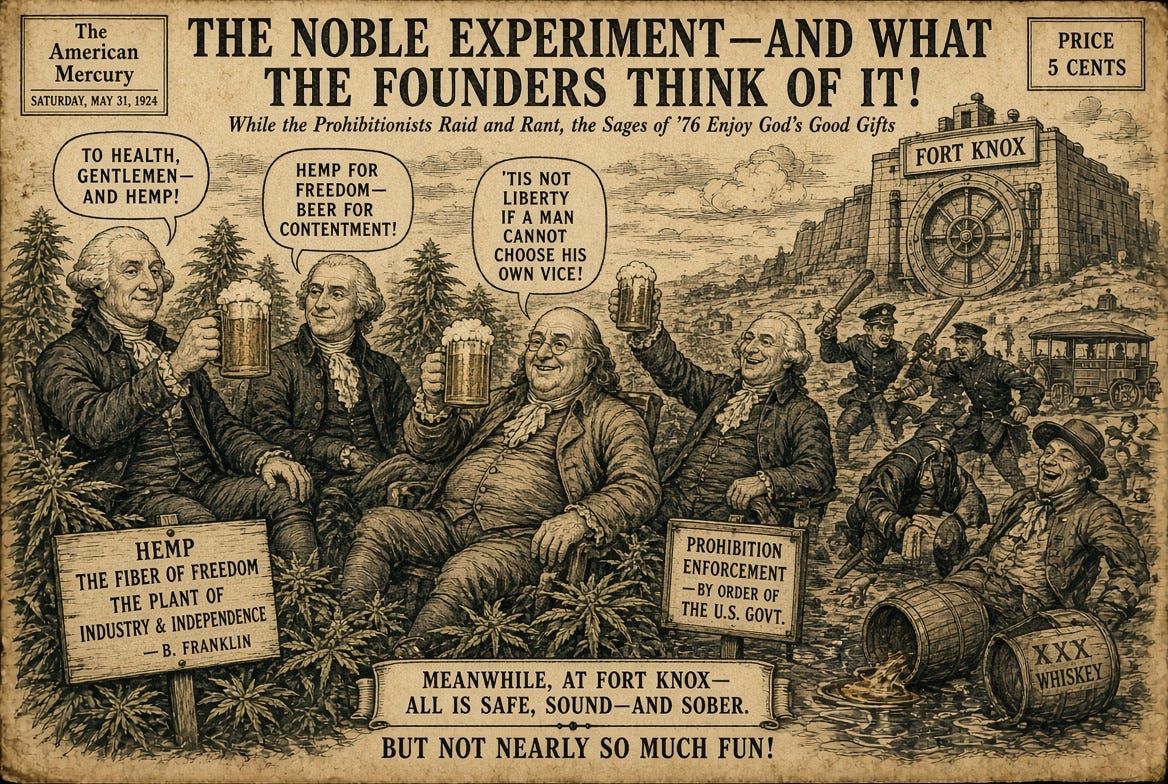
George Washington, the face on the dollar bill, was a farmer before he was anything else. Mount Vernon grew hemp. That’s the rope-and-sail cousin of marijuana, not the kind that gets you high. Hemp meant rope, sails, and clothes, and the country ran on it.
Thomas Jefferson was another hemp man. He wrote the Declaration of Independence while probably inhaling the sweet scent of cannabis leaves. Perhaps. Unlike a certain later president, nobody ever asked him if he inhaled.
And it wasn’t only hemp. John Adams, the second president, was a beer man. His Quincy, Massachusetts farm grew the malt and hops for a good brew. Or so the legend goes, and I like the legend. These guys were building a nation and tending their green crops at the same time. Remember that.
2. Almost Every Drug Comes From a Plant
The official War on Drugs started in the 1970s. The roots go way deeper.
Opium is the sap of the poppy. People have used it for thousands of years, as medicine and as a curse, from the ancient Sumerians to Victorian England. Cocaine comes from coca leaves, and it used to sit on pharmacy shelves as a tonic.
Here’s the truth. Most drugs come from plants. Morphine, codeine, heroin: all from the poppy. Cocaine: coca leaf. Marijuana: you know where that comes from. Even LSD is made from a chemical found in ergot, a fungus that grows on grain.
3. Opium and the Railroad
The transcontinental railroad cut through mountains and tied the coasts together. It cost a lot more than money.
Chinese laborers were worked like near-slaves. They blasted tunnels through solid rock, and opium got them through the pain. It also got its hooks in. Those iron tracks carried more than freight. They carried addiction.
4. Beer Built Nations
Beer is as old as civilization. The Sumerians brewed it. The men who built the pyramids drank it. When times were hard, beer was how people got together and got through. It was a currency of friendship.
Then came Prohibition in 1920, and beer was suddenly a crime. The temperance women marched with their “lips that touch liquor shall never touch mine.” The government took their cause and ran with it. The dry years ended in one big hangover. Beer came back in 1933, smack in the middle of the Great Depression, right when people needed it most.
5. Jazz, Racism, and the Prohibition Paradox
Black jazz musicians, horns wailing, found relief in marijuana and opium. White society was scared of their music. Scared it would steal their daughters’ hearts. Enter Harry Anslinger, the first boss of the Federal Bureau of Narcotics, who sold that fear to America with racist scare stories about jazzmen and reefer. In 1937 Congress passed the Marihuana Tax Act, and the Jazz Age played on out of tune.
And here’s the irony. The laws that were supposed to protect morality are what built the underworld.
6. The War Was Lost Before It Started
So the War on Drugs rolled on. It was lost from day one. Why? Because the legal drug dealers, the pharmaceutical companies, never stopped making money. They push pills, not poppies.
You can’t win this war. Burn one poppy field and a thousand more come up. As long as there’s pain, there’s going to be morphine, on the battlefield and in the hospital. The War on Drugs is a war against nature. It’s a war against ourselves.
7. COVID-19 Walks In
Then a new player showed up. COVID-19. Something you couldn’t even see wrecked economies, tore families apart, and left a trail of grief.
But what if it was more than a virus? What if it was a pawn on a bigger chessboard?
8. Morphine at Fort Knox
Think about Fort Knox. Everybody knows it holds the gold. What if it holds something stronger too? Morphine.
Here’s why that makes sense. When a country goes to war, morphine goes with it. It quiets the wounded and keeps the fight going. So what if that stash is more than a medical reserve? I’m not saying it’s there. I’m just asking what’s behind the door.
9. Hunter Biden and the Dance of Immunity
Then there’s Hunter Biden, son of Joe Biden. He’s struggled with addiction, and the story got wrapped up as a mental health issue. But what if there’s more to it? What if his drug years were a dance of immunity? Who’s going to come after the president’s kid?
Turns out, nobody. On December 1, 2024, his father gave him a full and unconditional pardon. Now that’s immunity.
Meanwhile the pharmaceutical companies keep their pills flowing like rivers and their profits climbing. To them, Hunter is a footnote in the ledger.
10. The Web
COVID, morphine, and Hunter. To me they’re threads in the same web. The drug war we lost has turned into a new one, and the drug companies are holding the reins. They sell vaccines, opioids, and antidepressants. Their labs turn out cures and addictions on the same line. And we’re the pawns.
The Real War
The drug war is a smokescreen. The real war is fought in boardrooms, not jungles. Remember this: the biggest drug dealers wear suits, not hoodies. They’re the ones pulling the strings.
So let’s raise a glass. Not to prohibition, but to understanding. To figuring out that the real fight is inside us, not against the plants that keep us alive.
And raise it one more time. Not to prohibition, but to revelation.
So the curtain comes down on this story of opium dreams, beer-soaked revolutions, and viral conspiracies. The world keeps spinning, and we sip our brews, pondering the enigma of it all. 🍻
============================================================
#17 WHEREVER I STAND
============================================================
Wherever I Stand
Four Great Lakes, one summer, and why I’m a water protector
Water Protectors, Great Lakes, Michigan, Nestle, Standing Rock, Indigenous Peoples, Columbus, LIFEAFTERLIES
TEASER:
Michigan touches four of the five Great Lakes. One summer I swam in every one. Columbus looked at the Taino and wrote “They have no iron.” Nestle looked at a Michigan well and paid $200. Wherever I stand is my land, and I will always protect the water.
LIFEAFTERLIES.substack.com
Mark T (Just until I update it with the proper spelling of his last name.)
I’m a water protector. Some people hear that and picture a protest sign. For me it started a long time before any sign. It started in the water.
One Summer, Four Lakes
Michigan is the Great Lakes State. It touches four of the five Great Lakes: Superior, Michigan, Huron, and Erie. One summer I swam in every one of them.
That’s not a brag. It’s a baptism, four times over. That water doesn’t care who you are. It just tells you the truth: you’re small, and it’s big, and it was here first.
Mark’s Lake Erie Story
Mark Theida (sp) once told me a story about his friend Tommy Gray. It was a Lake Erie story, and it was about Tommy’s wife. It’s Mark’s story to tell, not mine, so I’ll leave the details with him.
Some friends you make at work. Some you make at the bar. Some you make over water. Share it with somebody and you’re bonded. Heinlein called that being water brothers. This one’s for Mark.
They Drank Here First
Before it was the Great Lakes State, it was Anishinaabe country: the Ojibwe, the Odawa, and the Potawatomi, the Council of Three Fires. They drank from these lakes long before anybody sent them a bill.
They didn’t own the water. They belonged to it. That’s the whole difference between them and the people who came later.
“They Have No Iron”
In October 1492 Columbus landed in the islands. The Taíno came down to the beach to meet him. He wrote down what he saw in his own journal, in his own words.
“They have no iron.”
“It appears to me, that the people are ingenious, and would be good servants.”
“I could conquer the whole of them with fifty men, and govern them as I pleased.”
Every kid learns the rhyme about 1492. Nobody learns those lines. Read them again. The first thing he noticed about people who greeted him in peace was what they didn’t have. No iron. No weapons. So, servants.
That’s the same eye that looks at a lake today and sees product.
The Bill
Near the small town of Evart, Nestlé pumped groundwater from a well called White Pine Springs to bottle and sell. State records show what they paid Michigan for it: a $200 yearly reporting fee per site, plus $5,000 to apply for the 2018 permit. Meanwhile people I know in Michigan say they pay two to three times over for the water coming out of their own taps.
The Great Lakes State. Paying for its own water. While a corporation fills bottles for pocket change.
Pure Life was a Nestlé brand until Nestlé sold its North American water business in 2021. The bottles kept flowing. The plastic kept piling up. Out in the Pacific, the Great Pacific Garbage Patch spins, a floating continent of our leftovers, breaking down into microplastics that come back to us in the water we drink. That’s the bill nobody mails you.
I’ve kept a Nestlé globe cup for over 40 years. When I was a boy I thought it was the holy cup, the one that runneth over. Years later I looked again and saw the brand face smiling at a kid from the side of his water. That’s the trick. They put their name on the cup, then they put their name on the well.
In 2016 the Standing Rock Sioux and thousands with them stood against the Dakota Access Pipeline running under the Missouri River. They called themselves water protectors. Their words: Mni Wiconi. Water is life.
They were right. They’re still right.
What I Am
I’m not claiming anybody else’s history. Here’s what I’m claiming. I swam in that water. I drank it. My body is mostly made of it. That gives me a duty, not a deed.
I’m three months sober. My water is plain water now, and I’ve never been more grateful for a clean glass of it.
I AM, of the Brothers Water Mark. I don’t need a fence or a flag or a title to know where I stand.
Wherever I stand is my land, and I will always protect the water.